Non-contact position sensors in off-highway vehicle braking systems provide continuous, long-term reliable meaurement of brake pads in hostile environments
Continue reading
Non-contact position sensors in off-highway vehicle braking systems provide continuous, long-term reliable meaurement of brake pads in hostile environments
Continue reading
Threaded engine oil level sender for GT class race car
Continue reading
Maintenance is evolving.
The availability of new sensing technologies and products has enabled a move away from the older Reactive Maintenance (run to failure) and Preventive Maintenance (time based) approaches to the condition based strategy of Predictive Maintenance (PdM).
The rationale for PdM is that by carrying out maintenance only when it is required and by preventing machinery failures, costs are reduced and productive output is increased.
However, PdM requires upfront costs for the sensors and their installation. So, here are five things we feel support the case for condition monitoring and the return on investment it can offer.
1. Using case studies and cost justification exercises, the following comparative maintenance costs relating to power generation are;
(costs in US$,per Horsepower per year – Source; The Electric Power Research Institute)
2. The following benefits have been attributed to condition monitoring;
These figures may seem high, but in a typical manufacturing plant, a 10% reduction in maintenance costs has the same benefit to the bottom line as an increase in sales of 40%. Additionally, studies have shown that a properly implemented Predictive Maintenance programme supported by condition monitoring can replace up to 30% of Preventative Maintenance tasks.
3. Predictive Maintenance using one or more sensors is shown to decrease machine downtime four times more effectively than other methods. (Plant Engineering Magazine)
4. The measurable benefits Predictive Maintenance programmes in the oil and gas industry have shown, on average, are;
5. In relation to oil analysis as a condition monitoring technique-
“6.3.5 Equipment Cost/Payback
For facilities utilising a large number of rotating machines that employ circulating lubricant, or for facilities with high dollar equipment using circulating lubricant, few predictive maintenance technologies can offer the opportunity of such a high return for dollars spent. Given the high equipment replacement cost, labour cost, and downtime cost involved with a bearing or gearbox failure, a single failure prevented by the performance of oil analysis can easily pay for a programme for several years.”
(US Department of Energy’s O&M Best Practices Guide Release 3.0)

The benefits of a predictive maintenance strategy are well understood among plant and maintenance engineers in improving productivity by reducing planned and unplanned equipment downtime, as well as reducing maintenance costs by only undertaking service activities when it is required.
However, to realise these benefits requires accurate and reliable monitoring techniques to determine the health of the equipment, pinpoint an issue indicating when a service intervention is required. There are many methods and techniques for doing this and monitoring the lubricating oil – a machines’ blood supply – is one of the most effective for providing a very early indication of potential problems, allowing the most time for remedial action to be undertaken avoiding a catastrophic breakdown.
Gill Sensors and Controls introduced their innovative and market leading Oil Condition Sensor over 12 months ago and it bought to the market a compact, multi-parameter sensor that made oil analysis simple, accurate and real-time. Capable of measuring both fine wear and coarse failure ferrous debris independently, along with water in oil contamination and oil presence or temperature, the sensor makes available some of the key condition monitoring parameters for oil lubricated machinery in one device.
With a powerful magnet in the tip of the sensor to capture all the debris in the oil, the sensor can be installed in either an oil sump or an oil line. Because the sensor can provide the high insight value measurement parameters to both new and retrofit installations means that the number of mounting locations the sensor can be installed in is broad and diverse.
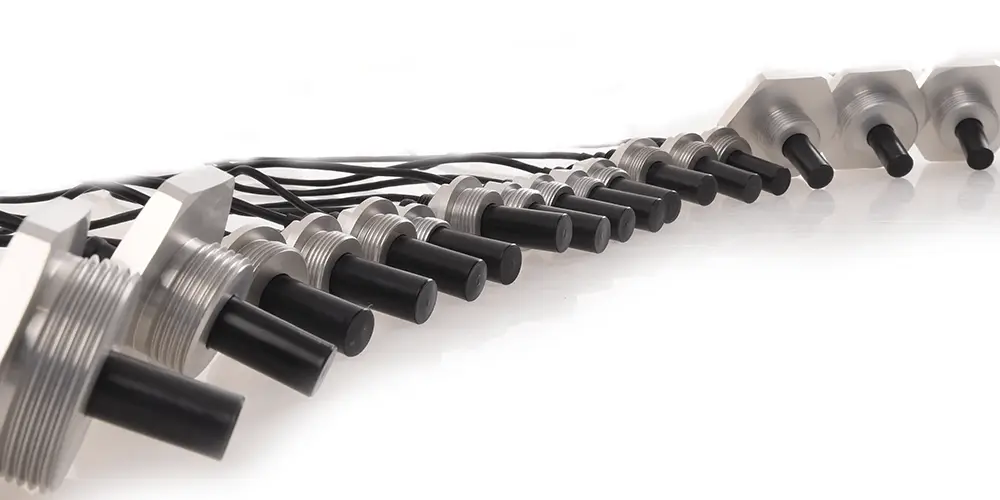
To meet the high demand from Engineers to take advantage of the benefits of the Gill sensor to improve the reliability performance of their oil lubricated plant, Gill has responded to their requests for a larger range of mounting options, making it even easier to install the sensor. By careful re-engineering of the sensor by their in-house design team, Gill can now offer a total of 17 thread mounting options, covering popular sizes and thread profiles, including Metric, UNF and BSPP.
Gill’s Product Manager said “We have listened to the feedback from our customers for a greater range of mounting options and this is the first stage of our response, making it easier to reap the benefits of this innovative condition monitoring sensor. We have more enhancements planned for later this year to further meet our customers’ needs and broaden the availability of the sensor.”

The 360 Rotary Sensor from Gill Sensors & Controls has been supplied for an earthquake simulator at one of the UK’s largest children’s theme parks.
Continue reading
Maintaining consistent water levels in swimming pools in the heat of Hawaii is challenging. A solid-state liquid level sensor has been installed allowing constant monitoring and automatic top-up.
Continue reading